






 SEO Services
 Local SEO
 ecommerce SEO
 Free SEO Audit
 Content Writing
 Google Review Management
 Google Penalty Recovery










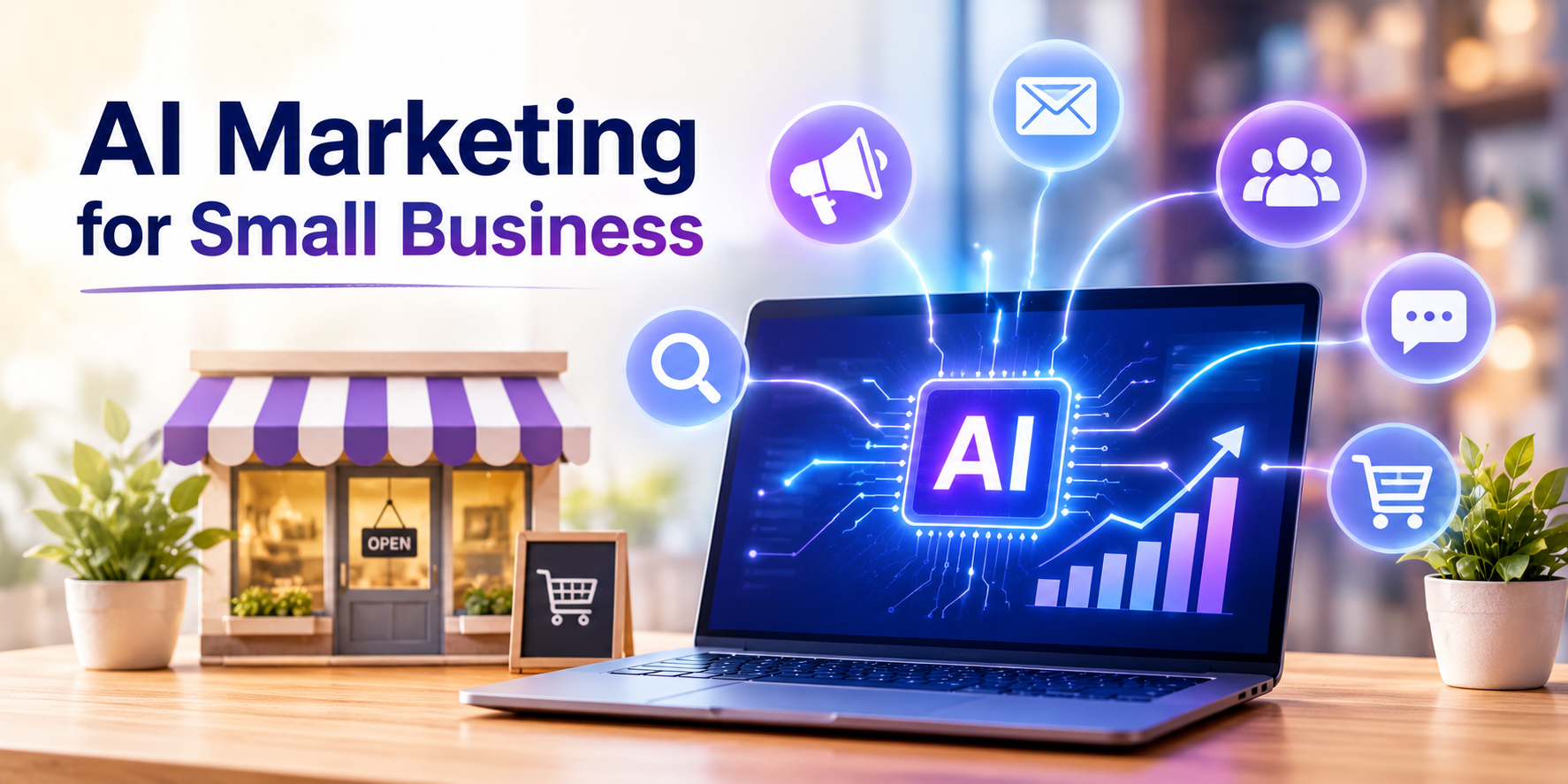
Most Australian small businesses can generate more qualified leads with AI right now, without hiring a data science team or overhauling their tech stack. The fastest wins come from using AI to speed up research, respond to enquiries faster, follow up more consistently, and free up staff time for the conversations that actually close deals. This guide covers 15 practical, low-risk ways to put AI to work in your marketing and sales process, where a person still needs to stay in control, and how to avoid the mistakes that waste budget and damage trust.
What “AI marketing” actually means for a small business
AI marketing is the use of machine learning and generative AI tools to support research, content production, personalisation, lead qualification and follow-up, so marketing and sales tasks happen faster and more consistently. It is not a replacement for strategy, and it is not a single piece of software you buy once. For most Australian SMEs, AI marketing means adding AI-assisted steps into an existing process, such as drafting a first version of a blog post, summarising a sales call, or triaging enquiries after hours, while a person reviews and approves anything that reaches a customer.
A related term worth defining here is AI lead generation: using AI tools to identify, attract, capture and qualify potential customers faster than a fully manual process allows, typically by combining better-targeted content, faster response times and more consistent follow-up.
This article is deliberately practical rather than a list of trending tools. For each use case below we cover the business problem it solves, where AI genuinely helps, where a person must stay involved, a low-cost first step, a risk to manage, and a KPI to track.
The 15 practical AI marketing use cases
1. Customer and market research
Business problem: Owners rarely have time to properly research competitors, customer language and market gaps before writing content or planning campaigns.
Where AI helps: AI tools can summarise competitor websites, review themes in customer feedback, and surface common questions from forums, reviews and search data far faster than manual research.
Where a person stays involved: Validating findings against your own sales and service experience, and checking that any competitor or market claims are current and accurate before they inform decisions.
Low-cost first step: Export your highest-performing search queries from Google Search Console and ask an AI tool to organise them by topic and intent.
Businesses requiring a complete search strategy can explore Verve Innovation’s professional SEO services.
Risk to avoid: Treating AI-generated market summaries as verified fact. Always check dates and cross-reference with a primary source before using a claim publicly.
KPI: Time saved on research per campaign or content brief.
2. Keyword and search-intent research
Business problem: Many small businesses guess at what customers search for, rather than confirming it with data.
Where AI helps: AI can cluster keyword lists by intent (informational, commercial, transactional) and suggest related questions worth answering on a page.
Where a person stays involved: Confirming actual search volume and competitiveness using a proper keyword tool, since AI assistants can misjudge how popular a term really is. Businesses that need expert-written material can use professional SEO content writing services.
Low-cost first step: Export your top 20 service-related keywords from Google Search Console and ask an AI tool to group them by search intent and suggest three content gaps.
Risk to avoid: Publishing content around a keyword an AI tool assumed was popular without checking real search data.
KPI: Non-brand impressions and click growth for targeted topic clusters.
3. Content briefs and first drafts
Business problem: Producing consistent, useful content takes more time than most small teams have.
Where AI helps: AI can turn a rough outline into a structured brief or a first draft, which is faster to edit than starting from a blank page.
Where a person stays involved: Every draft needs fact-checking, a rewrite in your own voice, and at least one genuine insight, example or opinion that could not have come from a generic prompt.
Low-cost first step: Use AI to turn your own notes or a recorded voice memo into a structured first draft, then edit rather than starting from scratch.
Risk to avoid: Publishing AI output with no expert review. Generic, unedited AI content is easy for readers, and increasingly for search engines, to spot.
KPI: Content production time and organic engagement (scroll depth, time on page).
4. Content refresh and repurposing
Business problem: Good content is often published once and never updated, even as facts, pricing or platform details change.
Where AI helps: AI can identify outdated statements, suggest updated headings, and repurpose a long article into social posts, an email or a short script.
Where a person stays involved: Verifying anything time-sensitive (prices, statistics, platform features) before republishing, and deciding what genuinely deserves a fresh angle versus a light edit.
Low-cost first step: Audit your five highest-traffic blog posts for outdated claims and ask AI to draft an updated outline for each.
Risk to avoid: Changing a published date without making a meaningful update, which damages trust with both readers and search engines.
KPI: Organic traffic movement on refreshed pages three months after update.
5. Lead-magnet creation
Business problem: Many businesses ask for contact details without offering enough value in return, which suppresses conversion rates.
Where AI helps: AI can help structure a checklist, calculator or short guide quickly, based on your expertise and the questions customers actually ask.
Where a person stays involved: Supplying the real expertise and examples that make the lead magnet genuinely useful, not generic.
Low-cost first step: Turn your most common sales-call answer into a one-page checklist and gate it behind a short form.
Risk to avoid: Building a lead magnet so generic that it could belong to any business in your industry.
KPI: Lead-magnet download-to-enquiry conversion rate.
6. Website chat and enquiry assistance
Business problem: Website visitors who have a quick question often leave rather than filling in a contact form.
Where AI helps: AI-assisted chat can answer common questions instantly and capture visitor context (service needed, location, urgency) around the clock.
Where a person stays involved: Reviewing chat transcripts regularly, escalating anything sensitive or complex to a human immediately, and being transparent that a visitor is talking with an assistant.
Low-cost first step: Begin with a simple chat tool covering the five questions customers ask most often. A well-planned business website design can also improve lead capture by combining clear information, strong calls to action and properly integrated enquiry tools.
Risk to avoid: Letting a chat tool make commitments (pricing, availability, guarantees) it isn’t authorised to make.
KPI: After-hours enquiry capture rate.
7. Lead qualification
Business problem: Sales time gets wasted chasing enquiries that were never a good fit.
Where AI helps: AI can apply consistent scoring rules to new leads based on budget signals, location, timing and service fit, and flag the strongest leads for immediate follow-up.
Where a person stays involved: Setting the scoring rules based on real sales experience, and reviewing edge cases where the rules don’t fit.
Low-cost first step: Write down the three questions that best predict whether a lead converts, then build a simple scoring rule around them in your CRM.
Risk to avoid: Over-relying on scoring without periodically checking it against actual sales outcomes.
KPI: Conversion rate from qualified lead to booked appointment.
8. Appointment booking
Business problem: Back-and-forth emails to schedule a call or visit slow down the sales process and lose momentum.
Where AI helps: AI-assisted scheduling tools can offer available times immediately after a form submission or chat conversation, reducing the gap between interest and a booked appointment.
Where a person stays involved: Confirming that booking rules reflect real staff availability and service capacity.
Low-cost first step: Connect your booking calendar directly to your enquiry form’s confirmation page.
Risk to avoid: Allowing automated booking to overpromise availability that doesn’t exist.
KPI: Time from enquiry to booked appointment.
9. Email nurturing
Business problem: Leads that aren’t ready to buy immediately are often forgotten.
Where AI helps: AI can draft a sequence of nurture emails and help personalise subject lines and content blocks based on what a lead showed interest in.
Where a person stays involved: Approving every sequence before it goes live, and checking tone matches your brand rather than sounding generic.
Low-cost first step: Build one three-email nurture sequence for your most common enquiry type and monitor open and reply rates.
Risk to avoid: Sending overly frequent or impersonal automated emails that feel like spam.
KPI: Nurture sequence reply rate and eventual conversion rate.
10. SMS follow-up
Business problem: Phone-based and trade businesses often lose leads simply because nobody answered the phone at the right moment.
Where AI helps: AI-assisted SMS follow-up can send an immediate acknowledgment after a missed call or form submission, then prompt a callback request.
Where a person stays involved: Setting clear rules for tone and frequency, and making sure a real person follows up promptly once contact is made.
Low-cost first step: Set up an automatic SMS reply for missed calls confirming you’ll call back within a set window, then make sure that promise is kept.
Risk to avoid: Automating a promise your team can’t consistently deliver on.
KPI: Missed-call-to-callback conversion rate.
11. Proposal and sales support
Business problem: Writing tailored proposals and follow-up messages takes time salespeople often don’t have.
Where AI helps: AI can draft a first version of a proposal or follow-up email based on notes from a sales conversation, and summarise a call recording into key points and next steps.
Where a person stays involved: Checking every commercial detail, pricing figure and commitment before it’s sent to a client.
Low-cost first step: Use call-summary software on your next three sales calls and compare the time saved on write-ups.
Risk to avoid: Sending an AI-drafted proposal with an incorrect price or scope because nobody checked it line by line.
KPI: Proposal turnaround time and win rate.
12. Review-request automation
Business problem: Happy customers are rarely asked for a review at the right moment, so review volume stays low.
Where AI helps: AI-assisted timing can trigger a review request automatically after a job is marked complete or an invoice is paid, and draft a short, personalised message.
Where a person stays involved: Never incentivising or filtering reviews in a way that breaches platform policies or Australian Consumer Law around genuine testimonials.
Low-cost first step: Automate a single review-request message triggered by job completion in your existing CRM or job-management tool.
Risk to avoid: Asking for reviews only from customers you predict will leave a positive one, which most review platforms prohibit.
KPI: Review volume and average rating trend month on month.
13. Paid-ad creative testing
Business problem: Small ad budgets don’t stretch far enough to test many creative variations manually.
Where AI helps: AI can generate multiple headline and copy variations quickly for structured A/B testing, and help interpret which combinations are performing.
Where a person stays involved: Making sure every claim in ad copy is accurate and compliant, and applying real judgement about brand tone.
Low-cost first step: Generate five headline variations for your best-performing ad and test them against the original for two weeks.
Risk to avoid: Approving AI-generated ad copy that makes an unsupported claim (for example, “guaranteed results”).
KPI: Cost per qualified lead by creative variant.
14. CRM data enrichment and prioritisation
Business problem: CRM records are often incomplete, making it hard to prioritise follow-up.
Where AI helps: AI can flag missing fields, suggest likely business categories from a website or LinkedIn profile, and highlight which contacts show the strongest recent engagement.
Where a person stays involved: Confirming that any enriched data is accurate before it’s used to make sales decisions, and respecting privacy obligations around how contact data is sourced.
Low-cost first step: Run an enrichment pass on your 100 most valuable open opportunities before a full database clean-up.
Risk to avoid: Enriching or scraping personal data in ways that breach the Australian Privacy Principles.
KPI: Percentage of CRM records with complete, accurate core fields.
15. Reporting, anomaly detection and next-best-action recommendations
Business problem: Marketing dashboards are often reviewed too late to act on a sudden drop in leads or a spike in cost per click.
Where AI helps: AI-assisted monitoring can flag unusual changes in key metrics and suggest a likely cause or next step, rather than waiting for a monthly report.
Where a person stays involved: Deciding what action to actually take, since AI recommendations reflect patterns in data, not full business context.
Low-cost first step: Set a simple automated alert for a 20% week-on-week change in enquiry volume or ad spend efficiency.
Risk to avoid: Reacting to short-term noise in the data without checking whether it’s a genuine trend.
KPI: Time between a performance issue occurring and it being addressed.
Comparison table: 15 AI marketing use cases at a glance
| Use case | Business problem | Suggested tool category | Human approval required | KPI | Implementation difficulty | Privacy/risk note |
|---|---|---|---|---|---|---|
| Customer & market research | Slow, inconsistent research | General AI assistant | Yes, before use | Research time saved | Low | Verify currency of claims |
| Keyword & intent research | Guessing search demand | SEO research tool + AI assistant | Yes, before publishing | Non-brand impressions/clicks | Low | Confirm real search volume |
| Content briefs & drafts | Slow content production | AI writing assistant | Yes, full edit required | Production time, engagement | Low-medium | Fact-check before publishing |
| Content refresh | Outdated published content | AI writing assistant | Yes, verify facts | Traffic uplift post-refresh | Low | Only update date with real changes |
| Lead-magnet creation | Weak value exchange for contact details | AI writing/design assistant | Yes | Download-to-enquiry rate | Medium | Avoid generic, low-value assets |
| Website chat | Missed after-hours enquiries | AI-assisted chat/live chat | Escalation rules required | After-hours capture rate | Medium | Disclose AI use; escalate sensitive queries |
| Lead qualification | Wasted sales time on poor-fit leads | CRM scoring/automation | Rules set and reviewed by a person | Qualified-to-booked rate | Medium | Recheck scoring against outcomes |
| Appointment booking | Slow scheduling | Booking/calendar automation | Availability rules confirmed | Enquiry-to-booking time | Low | Don’t overpromise capacity |
| Email nurturing | Forgotten unready leads | Email automation + AI drafting | Every sequence approved | Reply/conversion rate | Medium | Avoid excessive frequency |
| SMS follow-up | Missed calls losing leads | SMS automation | Tone and frequency rules set | Missed-call-to-callback rate | Low-medium | Keep promises made in automated texts |
| Proposal & sales support | Slow proposal turnaround | Call-summary + drafting tools | Every commercial detail checked | Turnaround time, win rate | Medium | Verify pricing/scope before sending |
| Review-request automation | Low review volume | CRM/job-management automation | No selective filtering of requests | Review volume/rating trend | Low | Comply with platform and consumer law rules |
| Paid-ad creative testing | Limited budget for manual testing | AI copy generation + ad platform testing | Every claim checked for accuracy | Cost per qualified lead | Medium | No unsupported guarantees in copy |
| CRM data enrichment | Incomplete records | CRM enrichment tools | Accuracy verified before use | Complete-record percentage | Medium | Respect Australian Privacy Principles |
| Reporting & anomaly detection | Slow response to performance issues | Analytics/reporting automation | Action decided by a person | Time-to-response on issues | Medium-high | Distinguish noise from genuine trend |
How to choose the right AI tool for each task
General AI assistants such as ChatGPT, Google Gemini, Microsoft Copilot, Anthropic Claude and Perplexity are useful starting points for research, drafting and summarisation, and several now include web search with citations. Which one suits a given task depends less on brand reputation and more on four practical factors:
- Data sensitivity: Customer names, health information or financial details should never be pasted into a general-purpose consumer AI tool without checking its data-handling terms and your obligations under the Australian Privacy Principles.
- Integrations: A tool that connects directly to your CRM, email platform or booking system will usually save more time than a general assistant used in isolation.
- Governance: Who reviews AI output before it reaches a customer, and what happens if the tool gets something wrong.
- Cost and the job being done: A free general assistant may be enough for internal research, while customer-facing automation (chat, SMS, email sequences) usually justifies a paid, purpose-built tool with proper audit trails.
Treat tool selection as an ongoing decision tied to the task, not a one-off purchase. Most Australian small businesses end up using two or three tools well rather than one tool for everything.
A practical starting point: pick one bottleneck, not fifteen projects
Trying to implement all 15 use cases at once is the most common reason AI marketing initiatives stall. A more reliable approach:
- List every point where a lead currently goes cold or a task takes longer than it should.
- Rank those points by revenue impact, not novelty. A slow callback on a missed call usually matters more than a smarter chatbot.
- Pick the single highest-impact bottleneck and fix it with the smallest workable AI-assisted step, using the “low-cost first step” suggestions above as a starting point.
- Measure the agreed KPI for four to six weeks before adding a second use case.
- Keep a person accountable for reviewing output at every stage, particularly anything that reaches a customer directly.
A Melbourne-based trades business, for example, might start with SMS follow-up on missed calls (use case 10) because that single gap is costing bookings every week, before layering in lead scoring or email nurturing once the first fix is proven.
Common mistakes to avoid
- Automating tone before automating substance. A fast, polished but inaccurate response damages trust faster than a slow, accurate one.
- Skipping human review on customer-facing content. Every AI-assisted message that reaches a real customer should have a clear point of human accountability.
- Chasing every new tool. Depth in two or three well-integrated tools beats a scattered stack of five.
- Ignoring privacy obligations. Sending customer data to a tool without checking its terms is a compliance risk, not just a technical one.
- Expecting AI to fix a weak offer or unclear positioning. AI speeds up execution; it does not replace a genuinely useful product or service.
Where SEO still fits into an AI marketing strategy
AI marketing does not replace search engine optimisation.
A business still needs:
- A technically sound website
- Useful and original content
- Clear service information
- Accurate local business details
- Proper internal linking
- Search-intent alignment
- Demonstrated experience
- Strong online authority
AI-supported research and automation can improve the process, but SEO remains essential for helping potential customers discover the business.
The relationship between the two disciplines is explained further in this comparison of an SEO company and an AI marketing agency.
Businesses can also read about how AI is changing SEO and what this means for Australian search visibility.
Frequently asked questions
Is AI marketing only for larger businesses?
No. Many of the use cases above, such as SMS follow-up on missed calls or an FAQ-answering chat widget, cost very little to start and often deliver the fastest return for small, service-based businesses.
Will AI marketing replace the need for a marketing person or agency?
Not for most businesses. AI speeds up specific tasks, but strategy, judgement, brand voice and accountability for customer-facing decisions still need a person or a trusted partner involved.
How do I know if an AI marketing claim is realistic?
Be cautious of any promise of guaranteed rankings, guaranteed leads or guaranteed AI citations. Search and AI-answer visibility is earned through consistently useful content and reliable execution, not bought outright.
Next step
If you want help identifying which of these 15 use cases would make the biggest difference to your lead flow, request an AI marketing opportunity audit and Verve Innovation will map your current process against practical, low-risk AI opportunities. Prefer to start smaller? Get in touch to talk through where you’re losing leads today.